

A peek into hands-on stewardship at the Snk'mip Marsh Sanctuary and how you can help
Ever since Haven for Ecology purchased the property that is now the Snk'mip Marsh Sanctuary, we've had a clear philosophy: engage the best professionals and experts and listen to them. This includes engineers, biologists, wetland restoration experts, reptile experts, bat experts, bird experts, botanists, those knowledgeable about removing invasive species... the list goes on.
Recently our very own expert, biologist Amber Peters (who is a Registered Professional Biologist) completed a third monitoring study at the Snk'mip Marsh Sanctuary and we're delighted to share some of her findings.
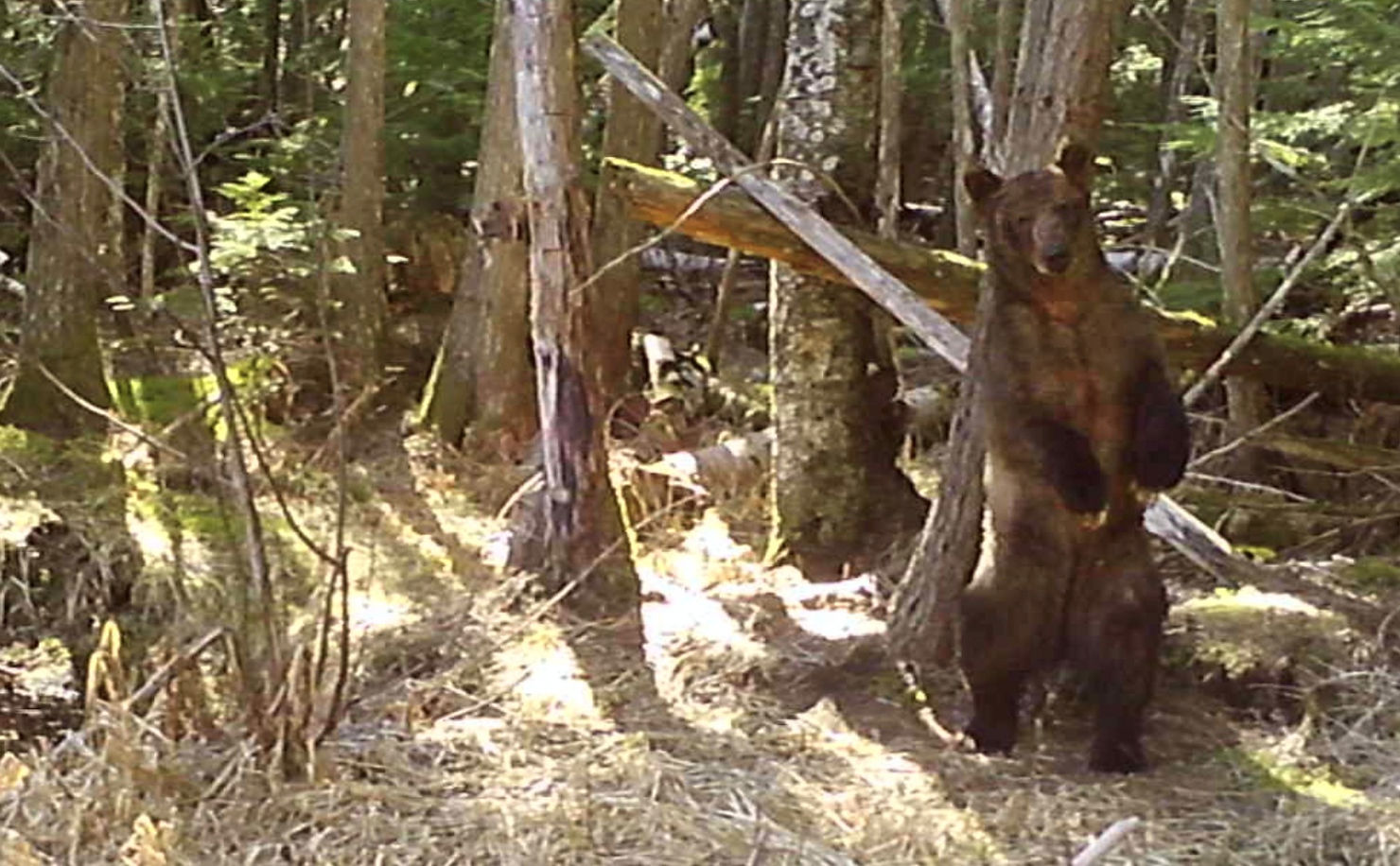
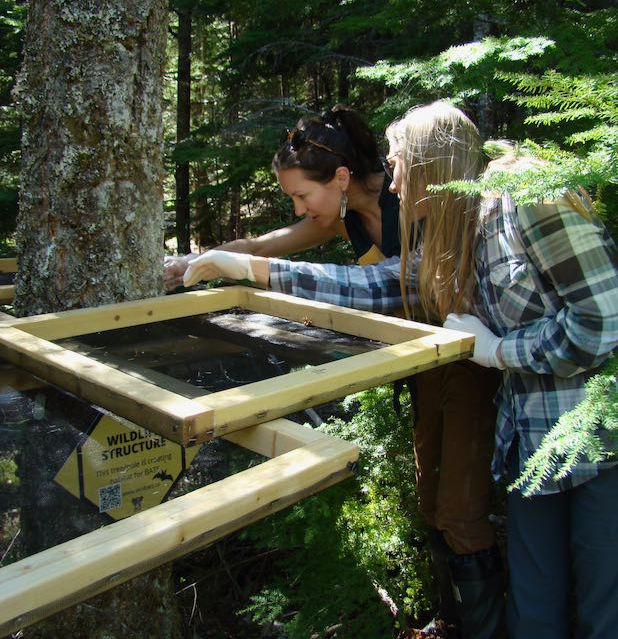
Biologist Amber set up remote cameras to record wildlife activity throughout the nature sanctuary and to attempt to measure the effectiveness of our restoration work. She had to wade through muck, crawl through thick brush, dodge thistles and thorns, survey every inch of the trails and pathways, and, when necessary, paddle-board into the very shallow marsh waterbody.
Amber counted salamanders and turtles and organized and tallied many hours of weed-pulling and replanting... then mapped and collated all that in a detailed report (available upon request by e-mail, you can reach Amber at: amberpeters@live.ca or send a note using the Contact Us form on our home page).
This is wonderful work! I'll help you save wild places for wild things!
To get caught up on some of our previous work at Snk'mip, take a look at these previous posts to get a sense of our work during the past 8 years, for example:
For 2025, here are some of Amber's key findings:
We protected the homes of a shy, at-risk salamander and set a provincial record for sightings of these Coeur d'Alene salamanders
Snk'mip Marsh and the adjacent rail-trail pathway is home to a significant population of blue-listed Coeur d'Alene salamanders (blue-listed is the provincial designation for this threatened species). These small amphibians are very difficult to find because they spend most of their lives hiding under rocks or in cracks in rocky hillsides. We identified a substantial habitat area along the boundary of our Snk'mip Marsh Sanctuary and we suspect they may also inhabit other areas along this rail-trail right-of-way.

Coeur d'Alene salamanders are an at-risk species in a family of lungless salamanders. Unlike some other species of salamanders, they are terrestrial: they breed on land and lay their eggs in cracks in/under rocks (hibernacula). Amber found a major habitat location at the sanctuary, likely one of what we call 'salamander palaces' (a rocky area where salamanders can safely overwinter). Fifty-four Coeur d'Alene salamanders were found adjacent to it during a single summertime night survey!
Based on the provincial government's assessments of the status of B.C.'s species and ecosystems, as ranked by the Conservation Data Centre (the CDC provides information on species and ecological communities at risk in British Columbia), this sets a provincial record for the number of individuals of this species officially identified in a single survey.
Without your help we literally could not do this vital work: please support our restoration of this precious marsh. A monthly gift is the best way to help as it supports stewardship on an ongoing basis and allows us to stay focused on our mission: 'saving wild places for wild things.' It's as easy as clicking this button...
This is wonderful work! I'll help you save wild places for wild things!
Learning where wildlife travel and what areas they frequent or avoid
Amber's monitoring showed that a significant number and diversity of wildlife use the forested areas of the sanctuary (and the surrounding area) as a travel corridor. This includes cougars, coyotes and grizzly bears using Snk'mip as a travel corridor between Valhalla Provincial Park and Goat Range Park. Travel corridors are vital for animal mobility and for genetic diversity.
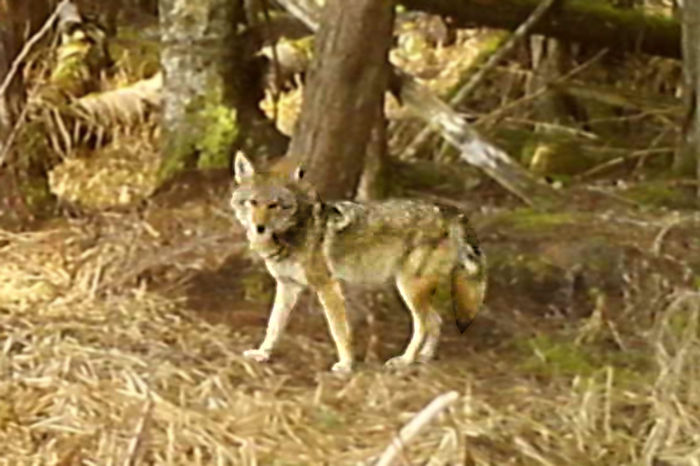
This forested area of the sanctuary is a low-human-disturbance area. It's fair to conclude that the absence of human presence is one reason that a larger number and higher diversity of wildlife use this area — as compared to the higher-human-use recreational trail (a restored railway line we call the rail-trail which forms the border of our nature sanctuary property). Some wildlife such as moose and deer have been documented using the rail-trail but our study shows that shyer creatures tend to avoid the areas routinely used by people (and their dogs).
Who uses the recreational trail (rail-trail)?
The results of this year's monitoring study indirectly support Haven's extensive work to ensure that the rail-trail was designated a non-motorized recreational trail. Our concern that motorized vehicle use on trails causes animal disturbance is well-founded, as proven by numerous scientific studies which have been compiled by our organization's other biologist Wayne McCrory (this report is also available on request).
Amber's 2025 monitoring showed that, even with only nonmotorized use (hikers and bicyclists) using the rail-trail pathway, shyer and more sensitive animals tended to avoid this area. We conjecture that this is because they were avoiding human (and dog) disturbance.

An interesting finding was how much more animal use there was on this recreational trail during the summer of 2024 when nearby raging wildfires and intense smoke made conditions dangerous and unhealthy for humans to recreate outdoors. During the summer of 2024, Amber's monitoring (using trail cameras) showed that animal activity increased significantly on the rail-trail at a time when human use of the trail was low, as compared to other years. During that same time, the quieter, forested area of the sanctuary also consistently saw a lot of wildlife activity.
We were frustrated by elusive turtles...
While we've occasionally seen Western Painted Turtles at Snk'mip since the completion of Haven for Ecology's major restoration works in 2020, on the whole these beautiful little reptiles have proven to be quite elusive.
We have not been able to determine how many WPTs there are in the marsh. We've documented multiple turtle sightings but do not know if that was the same turtle moving around or several different turtles! Our remote wildlife cameras did not capture any turtle photos, likely because they chose not to use those particular basking-log locations. Who knows the mind of a turtle? Not us, apparently!
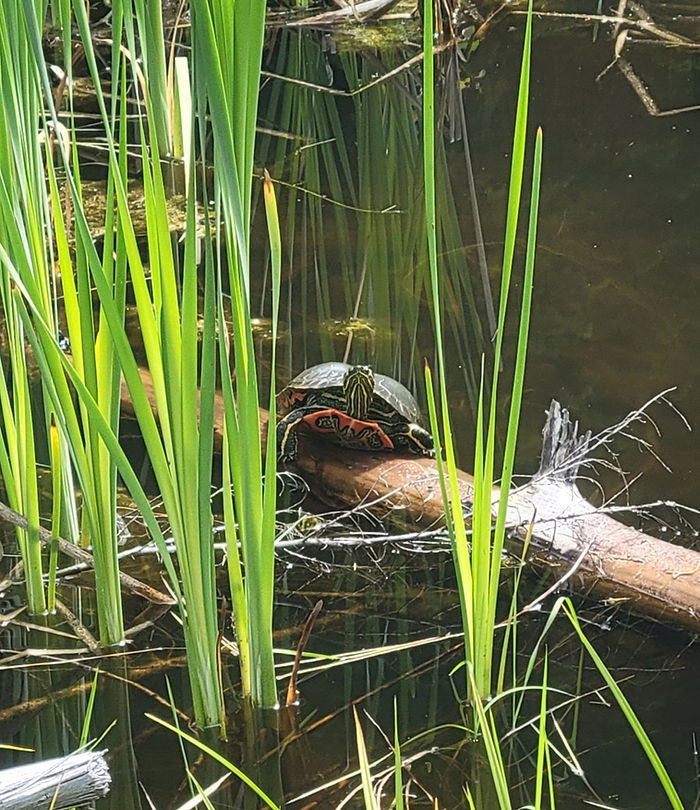
Public outreach asking people to report sightings in the north part of the Slocan Valley has so far only resulted in sightings at Snk'mip Marsh. We continue monitoring for Western Painted Turtles and encourage anyone who has seen a turtle in the north Slocan Valley to contact us.
Never in our wildest dreams did we anticipate the mountains of knapweed we'd have to pull!
Because the habitat of Snk'mip marsh and the surrounding upland areas was damaged prior to the property being acquired by Haven land trust, we inherited a huge number of invasive plants that took hold and put down deep, persistent roots and massive seed-beds — a considerable challenge for our restoration team.
We've tackled this problem by engaging teams of workers in spring/summer/fall to remove invasive plants by hand (no pesticides or herbicides are ever used in this wetland environment!) and to haul the plants out and transport them off-site for proper disposal. This provided valuable local employment for youth and for members of Wildsight's Youth Climate Corps. Everyone was happy to be doing such earth-positive restoration work.
Here are a couple of photos of our amazing crew at work:

Invasive plant removal has been a massive job, the scope of which we did not envision when we took on the property. Hand-removal of literal mountains of knapweed, thistle, burdock, oxeye daisy, and Saint John's Wort has been a huge undertaking that has required hundreds of hours of contractor work aided by some volunteer labour.
Revegetation with native plants (trees, shrubs, and native grass-seed mixtures) has been another huge undertaking, with thousands of plants put into the ground in the past 5 years. Continued stewardship will be needed to help native plant communities re-establish and out-compete invasives. It's hard work, but we persevere.
And finally... seems you can't please everyone
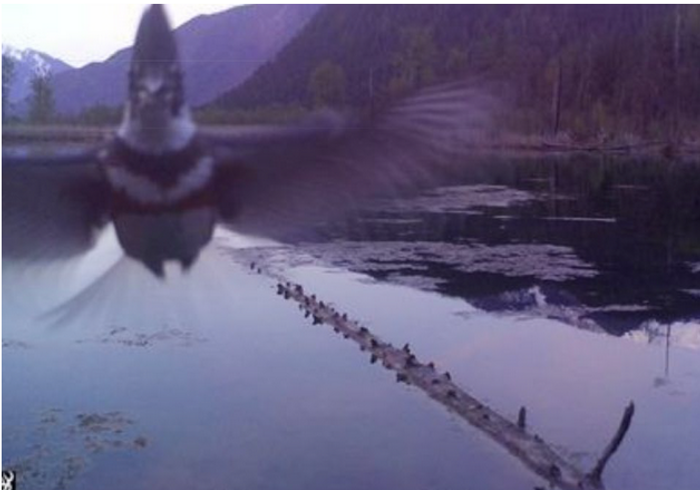
This angry bird was NOT happy with our wildlife camera, which had been placed on a basking log in the wetland. Our biologist Amber had to paddle-board deep into the wetland waterbody to place this camera -- and this is the thanks she gets! Clearly this Belted Kingfisher was not impressed, seen here attacking the camera. (In case you're worried, all annoying wildlife cams have now been removed.)