

At first, I thought it was a rock.
When I realized what it was, that this shy, beautiful creature had revealed itself to me, I was stunned. Tears of joy and relief fell unbidden.
Before me was one of nature's most cryptic wonders: an elusive, rare reptile that I have spent the past decade worrying about, fighting for,restoring and expanding its wetland habitat for, and defending against the motorized-use lobby that wants to keep roaring through the marsh where turtles get squashed by trucks and off-road vehicles.
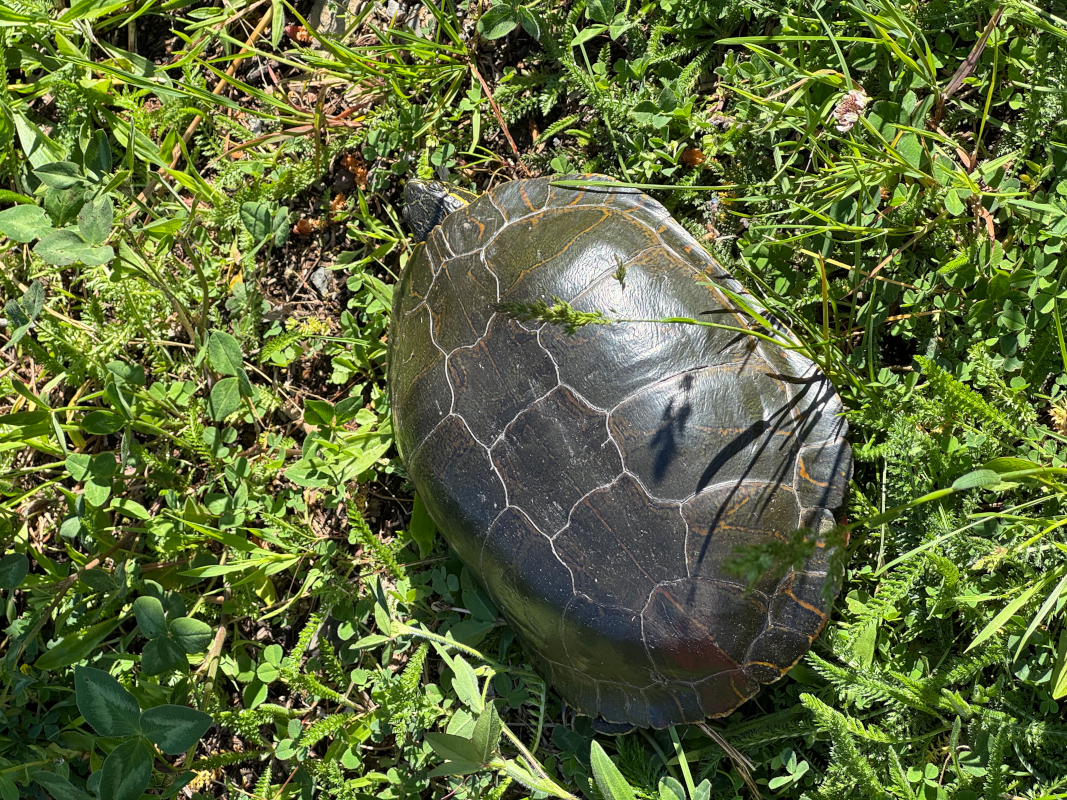
There it was, this spring at the Snk'mip Marsh Sanctuary: a Western Painted turtle. A threatened species*. Without our protection, destined for extinction. My reward after ten years of grinding work!
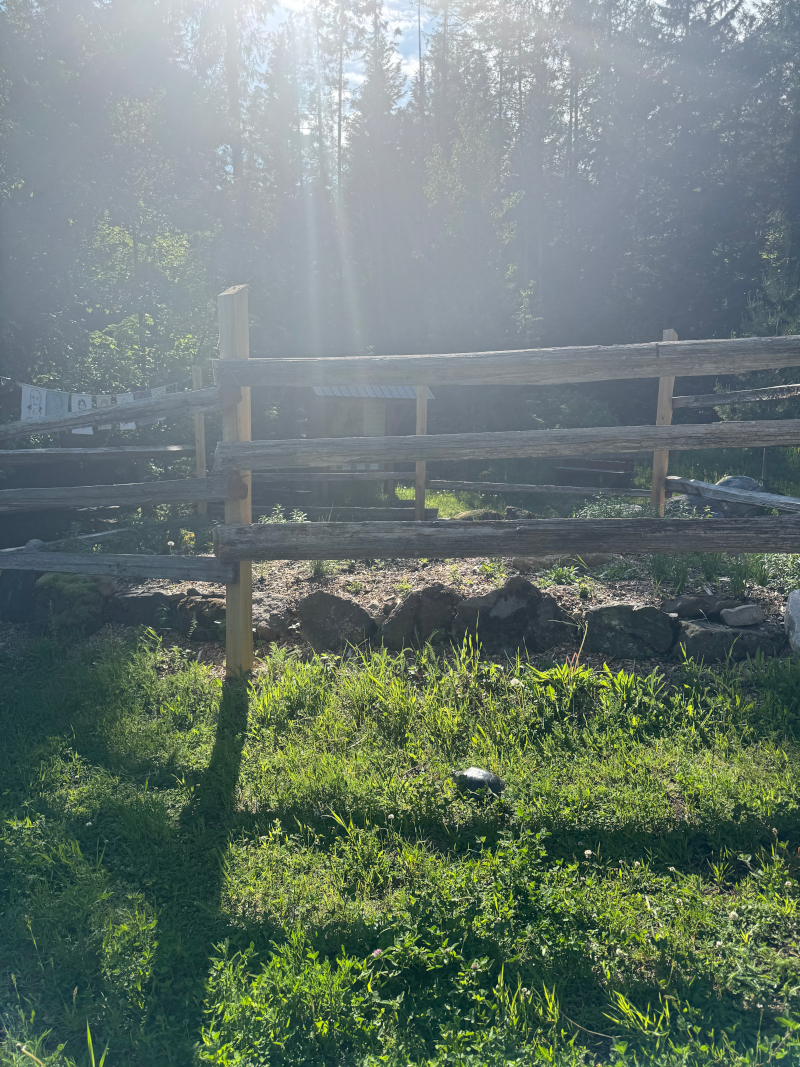
The turtle saw me. She blinked. She pulled her head and legs into her shell, with just the tip of her nose protruding slightly. A living, breathing Western Painted Turtle! I spoke to her softly and backed away to a respectful distance. The turtle was unimpressed by my reassurance. I moved away farther and sat down quietly. Satisfied, Madame Turtle sauntered nonchalantly into the brush and continued on her journey.
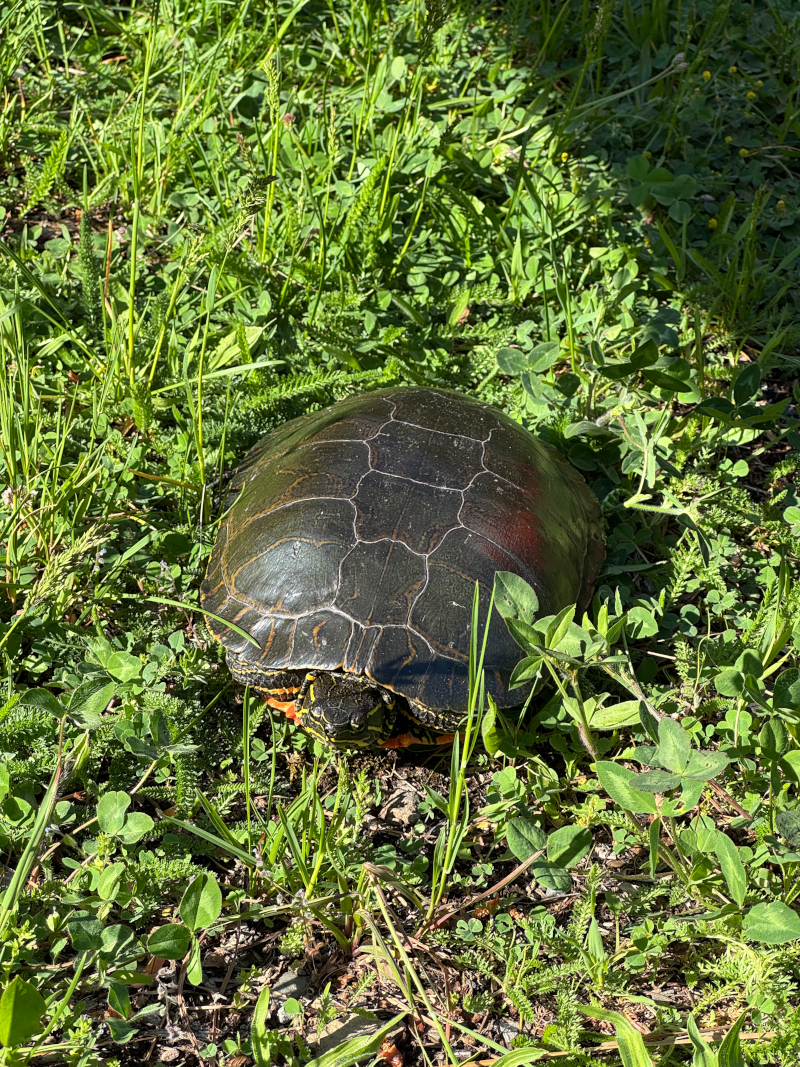
But wait. I pondered... what was she doing up here?
Turtles usually stay close to their ponds, where they feed on algae, aquatic insects, and small creatures, and bask on logs, soaking up the sun (being reptiles, they are cold-blooded and need the sun's warmth), ready to plop into the water for safety the moment a predator appears. So what was this turtle doing in this upland area of the sanctuary, near our pollinator garden?
When the realization hit me, more tears of joy sprang from my eyes. This must be a female, journeying to this warm, south-facing, upland slope to lay her eggs in the soft dirt of one of our new pollinator gardens. We had not only saved the turtles... we had created habitat where turtle eggs could be laid, so more of these rare creatures could thrive!
And with that, it all fell away. Every exhausting, scorching summer day spent raking rocks to create new ponds. The weeks of work over successive summers, choking on dust and wildfire smoke, as we did the restoration work on this property. The thousands of hours hunched over my computer, raising the money to acquire this property and then do so much critical restoration work. Even the threats we received from machine-riders who wanted to assert their "right" to roar destructively around the marsh ecosystem. All of it was gone with one blink from this turtle.
Thank you, Madame Turtle, for revealing yourself.
We protect that nesting site now, quietly, and keep watch over it from the same respectful distance she taught me that day.
The very next day, I was fixing the deer fencing around one of our new pollinator garden areas when I accidentally startled two outraged frogs. They leapt into a pond we created there four years ago. I recalled how that very spot had been a dead zone, a wasteland of knapweed strewn with industrial waste and residential garbage.Restored now, it is a verdant ephemeral pond that supports frogs, salamanders, toads, dragonflies, bees... the list goes on. And right next to it sits the cozy hibernaculum (basically a cave of large rocks) we built so that amphibians and reptiles can safely hibernate.
A turtle. Seeing those frogs. Dragonflies larking about in the cattails. Snk'mip provides rewards. At a time when social matters seem so vexingly fraught, this was a reminder that there are still places of refuge, and peace, and sanctity.
Will you join hands with me, for Madame Turtle?
Here is the part where I ask, from the bottom of my heart...
Everything you have just read took ten years. Turtle time is even slower: eggs laid in the spring hatch in the fall, and the babies stay underground in the nest all winter before they emerge (read below; it is astonishing). There is no finish line to this work. There is only the next season, and the next, and the next. Protecting a nesting site,fixing fencing, pulling weeds, planting, monitoring, defending the marsh when the machine-riders push back... that is what Haven does,every year, year after year.
That kind of steady, patient work needs steady, patient support. That is why monthly donors matter so much to us.
When we can count on your support every month, come what may, we spend less time on the grant grind and hunched over computers fundraising (believe me, I have put in those thousands of hours!), and more time where we belong: out at the marsh, saving wild places for wild things. We all want that, right?
A monthly gift does not need to be a princely sum: $20 a month, $15 a month, $10 a month... heck, even $7.50 a month makes a difference because we can count on it. Our partner CanadaHelps (itself a charity) processes your gift each month, and you receive one charitable receipt for the total of your monthly gifts each year, intime for income-tax filing. All gifts are tax-deductible.
Count me in... I will become a monthly turtle protector!
And if monthly giving is not for you, at least not right now? We understand completely. A one-time gift helps just as surely: it fixes deer fencing; it pays the weeding crew; it helps us protect a certain nesting site. If Madame Turtle's cool blink of an eye moved you the way it moved me, then please make a one-time donation of whatever amount feels right to you... Every gift counts, and every single one is received with gratitude.
I will make a one-time donation!
If you've read this far, I think you really want to help. Please do it now, before the next distraction of your busy day intervenes. Madame Turtle is counting on you... and so am I.
Yours in solidarity for the earth,
Lorna Visser
*The Painted Turtle (Rocky Mountain Population) is Blue-listed in BC and designated as Special Concern under Schedule 1 of the federal Species at Risk Act, due to habitat loss and alteration.*
Side note: a few more facts about these amazing creatures
Turtle courtship: Male painted turtles actively court females. A male follows a female and, facing her, vibrates his elongated fore-claws on either side of her face. He may repeat this courtship many times, swimming away between bouts and enticing the female to follow. A responsive female may reciprocate,vibrating her claws near the male's forelimbs. Courtship lasts up to15 minutes, after which the female sinks to the bottom of the pond,followed by the male, who mounts her from behind to mate. Outside of courtship and mating, males and females generally avoid each other.
Nesting: Females void cloacal water on their chosen nest sites and excavate a flask-shaped nest, all of 10 centimetres deep, using only their hind feet. After laying their eggs, the female fills in the nest cavity with the excavated soil and packs it down with intricate dance steps of her hind limbs. Then she leaves her egg-babies to incubate. There is no maternal care: they must fend for themselves.
Babies underground: Adult painted turtles hibernate in ponds or streams, but hatchlings usually overwinter right in the natal nest chamber, 10 centimetres or less below the ground surface. The eggs hatch in the fall, but the hatchlings do not emerge from the nest until the following spring.
Male or female? Sex is determined by the temperature the embryo experiences during a critical period of incubation. Eggs incubated at higher temperatures (constant temperatures of 29°C and above) produce females; lower temperatures (26°C and below) produce males.At a pivotal temperature of 28°C, roughly equal numbers of males and females hatch.
**The side note information comes from the federal Species at Risk Public Registry's COSEWIC assessment and status report on the Western Painted Turtle: https://www.canada.ca/en/environment-climate-change/services/species-risk-public-registry/cosewic-assessments-status-reports/western-painted-turtle-2012/chapter-8.html*